Santa Fe Springs, CA · Garage Door Service
Garage Door Spring Repair, Santa Fe Springs
Torsion and extension spring repair for Santa Fe Springs homes built mostly in the 1960s and 70s, where original hardware is finally giving out. Same fault, different decade of wear.
- Repairs & new doors
- Springs & openers
- Serving 4 nearby communities
Booking a Visit
When a spring goes, the door usually won't move at all, or it slams down the last foot with a bang that gets the whole house's attention. That's the call we want - don't try to force the door with the opener, you'll burn out the motor gears on top of the spring problem. Tell us whether it's a single door or a double, and whether you see one spring or two on the bar above the door. That's enough for us to roll a truck with the right spring on it instead of guessing. We work across the whole service area, not just the center of town, so when you call, say where you are relative to Santa Fe Springs - it helps us route the day. We don't quote a flat price over the phone because spring sizing and the condition of the rest of the hardware (cable, drum, bearing plates) varies house to house, even on the same street. What we will tell you up front is whether this looks like a straight spring swap or something the first tech needs to look at in person before pricing it.
What You Are Seeing
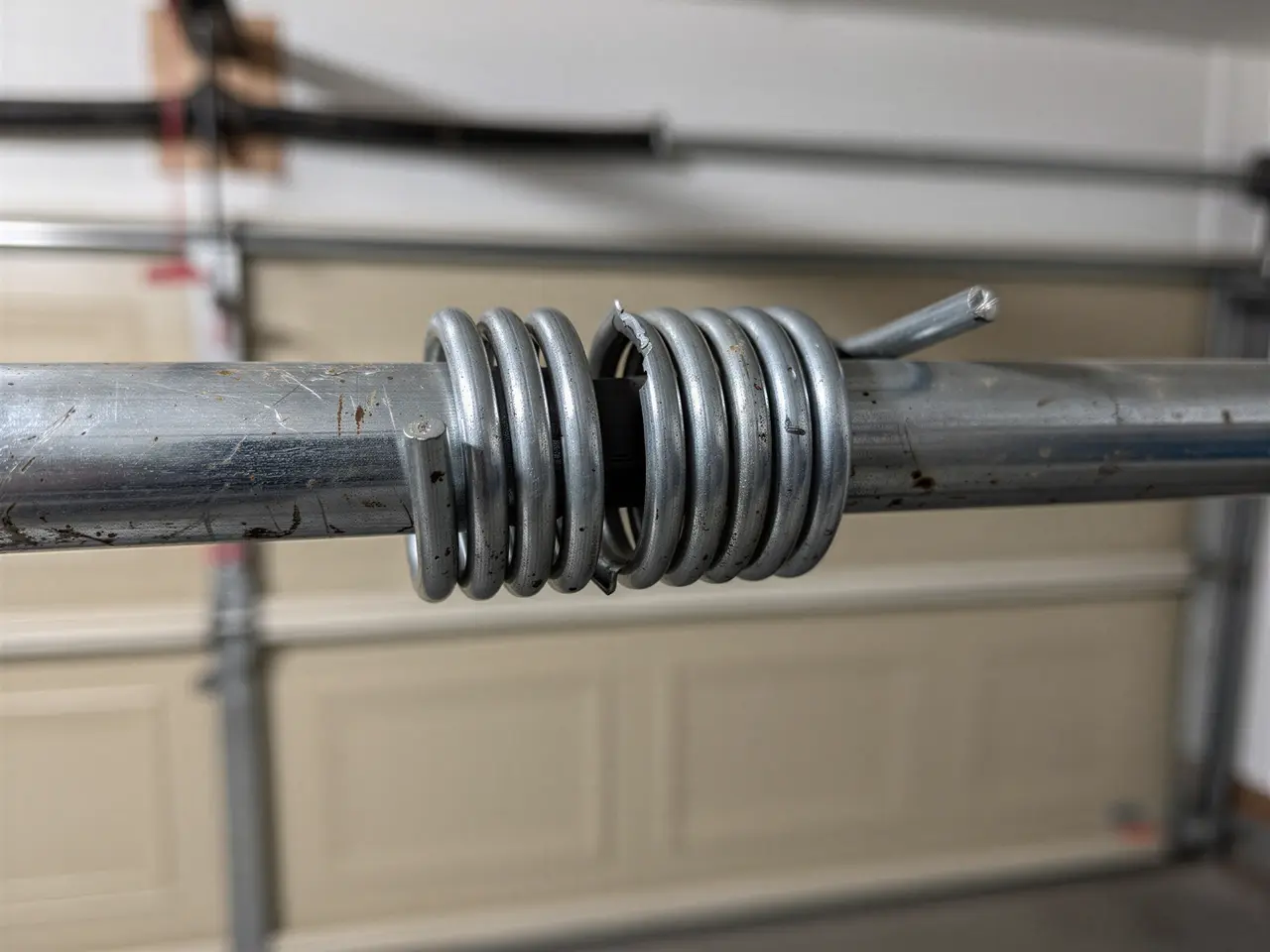
Most of what we're called out for is a torsion spring that's cycled past its rated life and finally snapped, or an extension spring stretched and frayed to the point a cable starts riding off the drum. On torsion systems - the single bar mounted above the door - one spring failing often still lets the door limp partway up before the second spring (if there's a two-spring setup) can't carry the weight alone. On older extension setups, you'll sometimes see the door hang crooked on one side, which means one spring has let go and the other is doing all the work. Either way, the door gets heavy fast, and a heavy door run on a bad opener chain or belt wears that part out too, which turns a spring job into two jobs if it sits too long. We see this across houses built anywhere from 1943 up through the 2000s in this area, but the bulk of what we're replacing sits in stock that went up through the 1960s and 70s - original or first-replacement springs that are simply at the end of their cycle count.
Why This Fails Locally
The housing stock across this service area runs 1943 to 2012 with a median build year around 1963, and most of the 32 named communities we cover lean hard into that 1960s-70s wave of construction. That matters for springs specifically because a torsion spring is rated in cycles, not years, and a door original to a 1963 build has had six decades to rack up open-and-close counts most other components never see. The mild temperate climate here doesn't add rust or ice-related stress the way harsher regions do, so when a spring fails in this area it's almost always straight fatigue - metal fatigue from cycle count, not corrosion. That's actually good news for diagnosis: we're not chasing weather damage, we're replacing a part that simply reached the end of its rated life on schedule. With 58,525 owner-occupied houses in the service area and household income running well above the regional median, we see a lot of homeowners who'd rather replace the spring correctly once than patch it twice.
The DIY Question
We'll say this plainly: don't do this one yourself. A torsion spring is wound under enough tension to break a wrist or worse if the winding bars slip, and extension springs under load have put people in the ER when a cable snapped loose. It's not like swapping a roller or lubricating a track. If you're comfortable doing your own hardware work, the safe DIY lane is replacing worn rollers, tightening loose track brackets, or lubricating hinges - not touching the spring itself. One honest limit on our end: if your door is original to a 1950s or early 60s build and the whole system - track, drums, bearing plates - is worn past matching new parts to old, sometimes a spring swap alone isn't the right call and we'll say so rather than sell you a spring that's fighting bad hardware around it.
Frequently asked questions
How do I know if it's the spring and not the opener?
If the door won't budge even when you pull the manual release and try to lift it by hand, that's a spring problem, not an opener problem. A healthy door should lift with moderate effort when disconnected from the opener. If it feels like dead weight, the spring has lost its tension or broken.
Why did my spring break with no warning?
Torsion and extension springs are rated in open-close cycles, and most fail at the end of that count rather than gradually weakening. A door that's worked fine for years can have a spring snap on an ordinary morning simply because it hit its cycle limit, not because of damage or weather.
Do you replace one spring or both on a two-spring door?
When one torsion spring breaks on a double door, we generally recommend replacing both, since the surviving spring is usually close behind on cycle count and was carrying extra load the moment its pair failed. We'll explain the reasoning on site before you decide.
By Neighborhood
Spring Repair across the Santa Fe Springs area
We also handle spring repair in these Santa Fe Springs-area suburbs.
Book garage door service in Santa Fe Springs
Call now or request a quote - tell us what the door is doing and where you are.