
Santa Fe Springs, CA · Garage Door Service
When a Spring Goes Stiff on a Cold Morning in Santa Fe Springs
A spring that seizes on a cold morning in Santa Fe Springs usually means older steel and original hardware. Here's what to check before you call anyone.
- Repairs & new doors
- Springs & openers
- Serving 4 nearby communities
Doing Nothing For Now
If your door is sluggish on a cold morning but still closes all the way and the opener isn't straining, you can wait a day or two before calling anyone. Santa Fe Springs sits in a mild temperate band, so you're not looking at the kind of hard freeze that snaps steel outright. Most mornings here, the dip is modest and temporary - the metal contracts a little, the lubricant thickens, and things loosen back up once the sun's been on the door for an hour.
What you shouldn't ignore is a door that groans, hesitates mid-track, or needs a shove to get moving. That's not the cold talking anymore - that's a spring losing tension or a roller binding on a track that's been flexing the same way since the house was built. With housing in this area going up mostly in the 1960s and 70s, a lot of these doors are running original or first-replacement hardware that's seen fifty-plus winters of this same small temperature swing, over and over. That repetition matters more than any one cold snap.
Waiting is reasonable for a day. Waiting a month on a door that's clearly struggling is how a stiff spring becomes a snapped one, usually while someone's halfway out from under it.
What to Check
Start by watching the door move, not just listening for it to finish. On a cold start, note whether it jerks at a specific point in the track - that's usually where a roller or hinge is losing to stiff grease, not the spring itself. Open it halfway by hand with the opener disconnected. If it drops on its own or feels heavy, the spring is tired, cold or not, and that's not a lubrication fix.
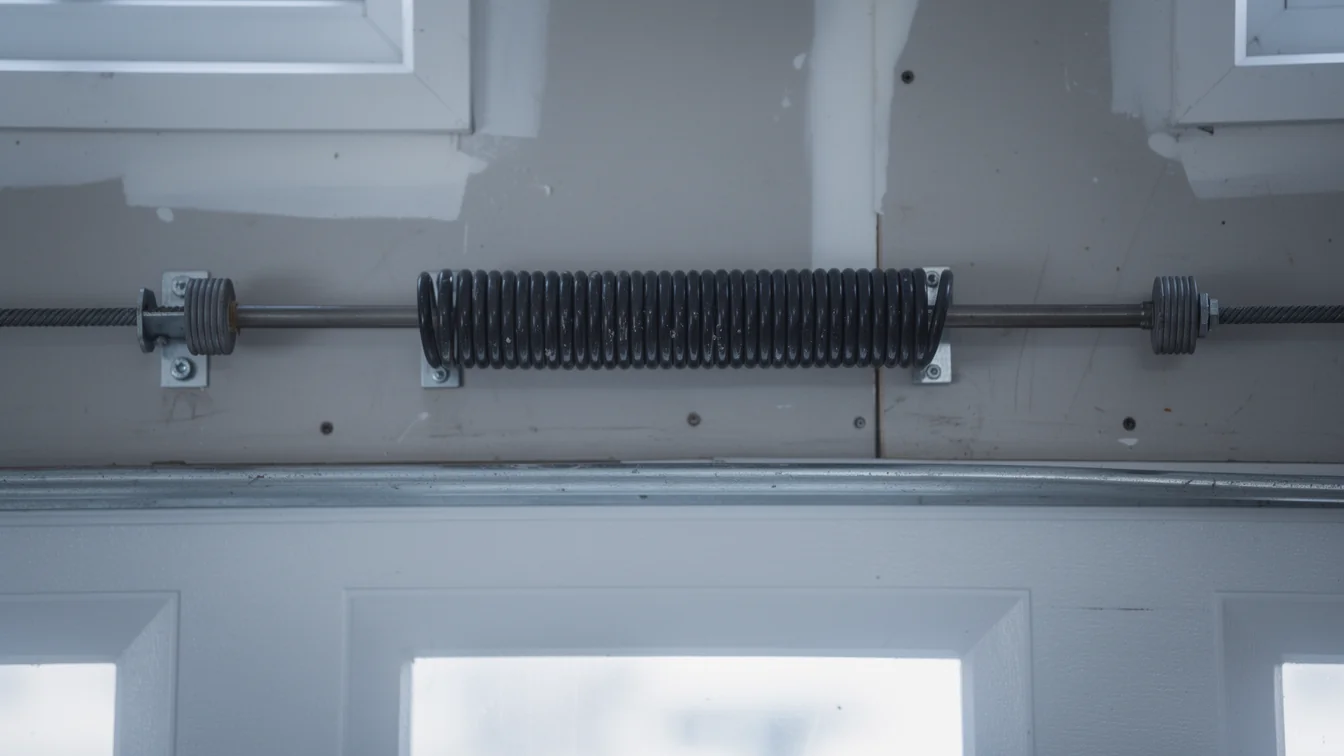
Look at the torsion spring itself if you can see it above the door - gaps between the coils, or a visible separation, mean it's done regardless of temperature. Check the bottom brackets and the cables for fraying, especially if your house dates to the earlier end of the 1943-2012 build range here, since older brackets were often painted over rather than replaced and hide rust well.
Last, check the opener's force setting hasn't crept up to compensate for a spring that's already lost tension - a lot of owners bump the force dial instead of addressing the spring, which just masks the problem until the motor gives out too.
The Problem
A spring doesn't fail because of one cold morning - it fails because thousands of cycles of modest temperature swing have fatigued steel that was never going to last forever anyway. Given that median year built here is 1963, a large share of doors in this service area are running springs well past any reasonable service life, cold weather or not. The cold just exposes what was already marginal: a spring near the end of its wind will bind and groan on a 45-degree morning when it would've been silent at 70.
The honest limitation here: once a spring shows gaps in the coil or visible stretch, there's no tightening or lubricating it back to healthy. Replacement is the only real fix, and on a double door that means two matched springs, not one - running mismatched tension is its own problem. If your opener is also straining to compensate, that's often a second job, not a free add-on to the spring work.
How Local Conditions Play In
Santa Fe Springs doesn't get the deep freezes that crack steel outright, but the mild temperate swing here still does real work on old torsion springs and painted-steel brackets over decades. It's a slow grind rather than a sudden failure - which is exactly why so many of these doors seem fine until one cold morning when they suddenly aren't.
Because so much of the stock here dates to the 1960s and 70s, the hardware on a lot of these garages has never been fully replaced, just patched - a cable here, a roller there. That piecemeal history means a spring failure often reveals other tired parts at the same time: a worn bottom bracket, a track that's slightly out of plumb from decades of settling. None of this is dramatic. It's just age plus routine temperature cycling, doing what it does.
Frequently asked questions
Why does my garage door only stick in the morning?
Cold overnight temperatures thicken old grease on rollers and hinges and make steel contract slightly, so things bind until the day warms up. If it loosens up on its own by afternoon, that's lubrication and age, not a failed spring. If it stays stiff all day, the spring itself has likely lost tension.
Is it the cold or just an old spring?
In this area it's rarely the cold alone - our winters aren't severe enough to snap a healthy spring. It's almost always a spring that's already near the end of its life from years of normal cycling, with the morning chill just making the symptom more obvious.
Can I lubricate my way out of a stiff spring?
You can lubricate the rollers, hinges, and track and that often fixes morning stiffness that's really a friction problem. But if the spring itself is gapped, stretched, or visibly loose, lubrication won't restore tension - that's a replacement, not a maintenance task.
Related garage door services in Santa Fe Springs
More garage door guides
Book garage door service in Santa Fe Springs
Call now or request a quote - tell us what the door is doing and where you are.