
Santa Fe Springs, CA · Garage Door Service
Weather Seals and Drafts on Santa Fe Springs Garage Doors
A look at why older Santa Fe Springs garage doors let in drafts, what to check before calling anyone, and why mild weather lets some owners wait on repairs.
- Repairs & new doors
- Springs & openers
- Serving 4 nearby communities
Doing Nothing For Now
If your door has a gap at the bottom or a draft along one side, you don't have to drop everything. A bad weather seal is almost never an emergency. Most houses in this area went up between 1943 and 1963, with the bulk of the stock dating to the 1960s and 70s, and the original bottom seals on those doors were never built to last sixty years anyway. The rubber hardens, shrinks, and pulls away from the slab. That's wear, not failure.
Waiting a season costs you a little comfort and maybe a few more leaves or a stray draft of outside air, but it doesn't put the door out of service. The track, the springs, and the opener keep working fine with a bad seal. If the gap is small and even along the bottom, you can reasonably let it sit until you're doing other work on the door, or until it bothers you enough to fix in an afternoon.
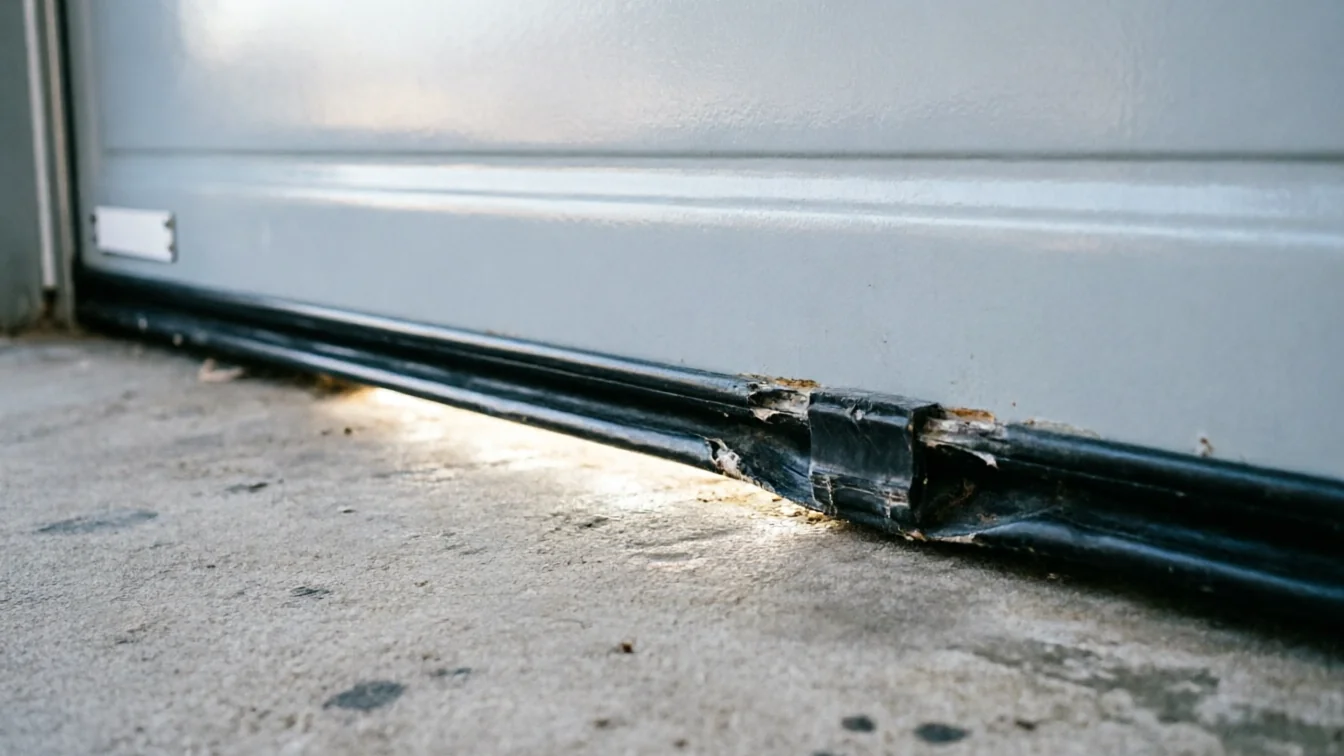
What changes the math is a seal that's torn in one spot, letting water pool under the door, or a side seal that's come loose and is catching on the track when the door runs. That's a different problem and worth checking sooner. Otherwise, a stiff or shrunken seal on its own is low priority.
What to Check
Start at the bottom edge. Close the door and look for daylight along the slab - a thin, even line usually means the seal has just hardened with age, common on doors installed any time from the 1960s through the 1990s. A line that's wide on one end and tight on the other usually points to the door or track being slightly out of level, not the seal itself.
Next check the side jambs and the top header. Run a hand along the weatherstrip where the door meets the frame. If it's brittle, cracked, or crumbling when you press it, it's past useful life. If it's intact but just sitting loose, it may only need re-tacking.
Look at the bottom corners specifically. On older doors with the original aluminum retainer track for the astragal seal, the track itself can bend or fill with grit over decades, and a new seal won't seat right until that's cleared out. with F2 in mind, a lot of houses here still have hardware dating to that 1960s-70s build wave, so the retainer track is often the actual culprit, not the rubber.
Finally, check whether the gap changes with the season. A door that seals fine most of the year but gaps in one stretch usually means the panel or track has shifted slightly, not that the weatherstrip failed outright.
The Problem
The core issue is mismatch between original hardware and a door that's been painted, adjusted, or re-hung once or twice since the house was built. With a median build year around 1963 for this area, a lot of these doors and frames have had at least one repair cycle already, and seals get replaced piecemeal rather than as part of a full weatherstrip job. The result is a bottom seal that's newer than the side jambs, or a side seal that's a different profile than what the retainer track was built for.
Draft complaints usually trace to one of three things: a bottom seal that's simply aged out, a track or jamb that's shifted enough that no seal seats evenly anymore, or a panel that's slightly warped from decades of sun and temperature swing. The first is a cheap fix. The second and third usually mean the door needs more attention than a new strip of rubber.
One honest limitation: if the door itself has warped or the jamb has moved out of square, a new weather seal will look fine for a few weeks and then gap again in the same spot. In that case, the seal was never the real problem, and replacing it without addressing the frame is money spent twice.
How Local Conditions Play In
This area sits in a mild temperate band, without the hard freeze-thaw cycles that crack weatherstrip in colder climates or the extreme heat swings that bake it brittle in a couple of summers. That's part of why seals on houses here, including the older stock built as far back as 1943, often last longer than the manufacturer's rated life before they visibly fail. It's not unusual for a seal installed in the 1990s to still be functional, just stiff.
The tradeoff is that because failure is slow and mild, owners tend to notice drafts only when they're already pronounced, since there's no sharp seasonal signal like a frozen door or a seal that splits in a cold snap. You don't get a single bad week that forces the issue the way colder-climate towns do.
Across the wider service area - from Los Nietos a couple miles out to places like Artesia and La Palma five or six miles off - the housing stock runs the same mix of 1960s and 70s construction, so the same slow-wear pattern on seals shows up on very similar timelines. There's nothing specific to any one of these streets; it's the age of the stock and the mild climate working together, not a local weather event.
Frequently asked questions
Do I need to replace my garage door weather seal every few years?
Not in this climate. Without hard freezes or extreme heat swings, seals here often outlast their rated life. Check for cracking or hardening by hand rather than going by age alone. A seal that still flexes when pressed is still doing its job, even if it's a decade old.
My door seals fine in some spots but gaps at one corner. Is that the seal?
Usually not. An uneven gap points to the door or track shifting slightly, common on houses with original hardware from the 1960s-70s build wave. Replacing the seal alone won't fix an uneven gap caused by a frame or track issue.
Can I ignore a drafty garage door through the winter here?
Generally yes, since the climate is mild and a draft doesn't threaten the door's operation. Keep an eye on standing water under the door if the seal is torn rather than just hardened - that's the one version of this problem worth acting on sooner.
Related garage door services in Santa Fe Springs
More garage door guides
Book garage door service in Santa Fe Springs
Call now or request a quote - tell us what the door is doing and where you are.